Monday, August 24, 2009

Wanderings


Lately I've been exploring the fortresses around Seoul. First up was Hwaseong Fortress, a UNESCO World Heritage site which is about half an hour southwest of Bundang. The entire structure, which dates back to the Joseon period, is huge, so I only had a chance to the visit the haenggung, or "detached palace" where the king would conduct business when he traveled to the fortress.

Some say that once you've seen one Korean palace you've seen them all, but I would respectfully disagree. I've found that despite the common colors, shapes, and patterns, each palace has its own distinct character. For example, Hwaseong Haenggung featured more of everyone's favorite mannequins than the other palaces.


The king's father had been imprisoned in this wooden chest when he was a boy because his father felt he was unfit to be king

mannequins celebrating the king's mother's birthday

someone forgot to finish these mannequins

As luck would have it, there was a film crew on site the day I visited. I'm not sure what they were filming, but it was an interesting glimpse into the world of Korean film. The only thing that seemed to be missing was a craft service table with kimchi and ddukbokki.


The palace looks pretty impressive, right? Just like a page right out of a history book? I thought so too- until I went to the info center and found out that almost the entire structure was a REPLICA which had been completed around 2005. Most of the palace had either fallen into disarray or been destroyed during the Japanese occupation. At least it gave some Koreans a chance to practice making replicas.


In between fortress hopping, I paid a visit to Cheong Wae Dae, the "Blue Roof House" where the South Korean President lives and works. It was pretty underwhelming. The tour guide basically showed us the President's park, then walked us by a couple buildings before calling it a day.

Supposedly this tree is very old and famous
No sightings of President Lee Myung-bak

The next fortress on my agenda was Namhansanseong, the forest-mountain fortress. This defensive structure was built to protect Seoul from southern invaders and now seems to be a favorite hiking spot for old Korean men and women. The low fortress wall follows the entire mountain range, encircling a small traditional town and other temples and structures.


Korea's very own [semi] Great Wall
Seoul skyline through the smog


lookout tower on the west side

Sadly, there were no mannequins at Namhansanseong, but I think the scenery more than made up for it.

Thursday, August 20, 2009

The Crazier Side of Seoul


Later that week I managed to end up in Itaewon, the foreigner district, twice despite never having visited at all prior to that. It became a running joke among the teachers that I was always in Itaewon, a joke that gained in popularity and hilarity after one teacher pointed out that Itaewon is also the red-light district of Seoul.

To be frank, Itaewon didn't impress me much and those two visits are the only visits I plan to make there. I had expected it to be a modern district full of American chains and goods, but found it was actually an older, run-down area with an eclectic mix of decent but expensive restaurants and bars.

The first time I went was on a Tuesday afternoon to visit a travel agent. Her office was two blocks from the subway station, with the first block feeling like China and the second block reminiscent of Wickenden St. in Providence. After meeting with the agent, I met up with Jihoon and Gina, who had recently arrived in Korea after studying abroad in Japan. Jihoon, who was preparing to return to the States, suggested we try a well-known burger place run by a Cornell grad, Smokey's Saloon. Smokey's menu featured edibles such as "Ambulance," "Kiss Me Later," and "Volcano." We ended up at a Dunkin Donuts, which in Korea are more ubiquitous and luxurious than in the US, before calling it a night.


The second time I visited was on a Saturday night with my Filipino friend from the goshitel. He's doing a doctoral fellowship in Korea but, like me, doesn't speak any Korean. Saturday night is apparently when all the Americans come out to Itaewon, as the bars were packed and the streets were full of people speaking in a tongue which was actually intelligible. We met up with some of his Filipino friends to have dinner at a Pakistani restaurant. As a Chinese-American, sitting in that restaurant in the middle of Seoul in the midst of a conversation being conducted in Tagalog as Pakistani music played on the TV overhead, I experienced one of the most surreal moments of my trip thus far.


***

I managed to find out more information about the psycho Korean politician my students have been talking about. His name is Huh Kyung Young, and his outlandish claims include:

-his IQ is 430
-he was a "secret" advisor to former President Park Chung-hee
-he can levitate (which he does by sticking one foot out in the air)
-he can heal arthritis by touching those afflicted
-he met with President Bush, who suggested he become Secretary-General of the UN
-if elected President, Park Chung-hee's daughter would marry him

And his campaign promises? Even better:

-abolish the Korean SAT [no wonder 100,000 Koreans voted for him in the last election]
-to reduce the number of members of Parliament and conduct a mandatory aptitude test for all of them [given the state of the Korean parliament, see above comment]
-to pay newly wed couples about $80,000
-to pay senior citizens about $24,000
-to move the headquarters of the UN into the DMZ

He wouldn't merit any attention but for the fact that 100,000 Koreans voted for him in the last election, and his new rap song has been getting radio airplay.

Huh was put in jail after the last election, for putting out false election promises and defaming Park Chung-hee's daughter. He was just released last month and emerged, he said, having been visited by Michael Jackson's spirit. MJ's spirit encouraged him, a 58-year old man, to release a rap song called "Call Me." The lyrics include:

Look into my eyes
You will be happy
Call "Huh Kyung Young"
You will be healthy
If you shout "Huh Kyung Young" you'll pass your tests
Look into my eyes
You'll lose weight


Gotta love Inspector Gadget. I can't help laughing every time I hear this song. Whether Huh is truly crazy, whether he's trying to start a new cult, or whether he's a genius poking fun at Korean politics is irrelevant- if people around the globe could only hear his song, I have no doubt the world would be a happier place.

Wednesday, August 19, 2009

North to Go South


After waking up with a stomach full of steak and Korean food the next day, I went to church then met up with Jihoon and Julia to go to Namdaemun (South Gate) market. The gate, which is on the northern side of Seoul past the Han River, was so-named because it sat at the south of historic Seoul, before newer developments like Gangnam arose.

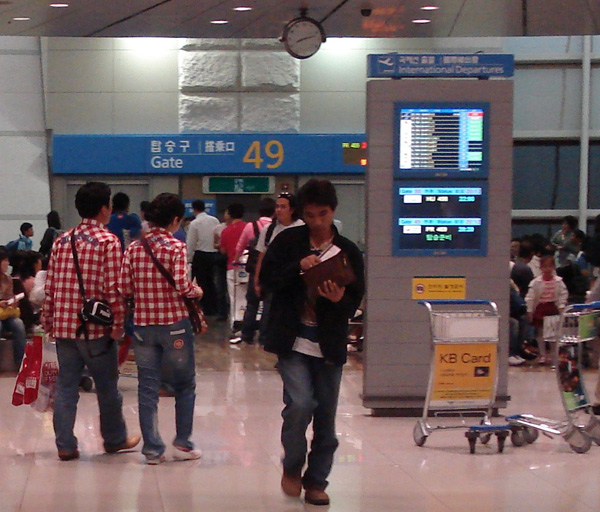
One of the more unsettling trends among young Koreans is matching couple outfits. I'm not talking about couples just wearing similar colored shirts, but about couples who actually wear the exact same shirts (and even pants sometimes). Jihoon says most Koreans choose to eschew individuality in favor of promoting their "coupleness."


On this particular Sunday, however, I noticed a particularly disturbing new trend- friends coordinating their outfits to match not just each other, but also to match the subway. I snapped a quick shot of one such pair on the Green Line.


Disturbing

Namdaemun market is the closest thing to a Chinese market in Seoul, with vendors prominently hawking their wares and streets overflowing with people. Some of the more common items for sale were handbags, suitcases, toys, and (authentic?) fox furs.


We also tried some fresh baos/mandu right out of the steamer, including some kimchi baos- the epitome of Chinese-Korean fusion
But baos alone weren't good enough for a full meal, so we headed over to a restaurant/food stall that Jihoon had seen on TV (although all of the restaurants in that row were advertising how they had been on TV). The dish was sujebi, homemade flour noodles. The owner whipped up a batch of fresh noodles with breathtaking speed, and apparently when she had been on TV she had thrown the noodles into the pot from a couple feet away. We asked her to demonstrate, but she just started bragging about how good she was instead of proving those claims.


We followed up the meal by perusing the American-snack booth and Korea's largest stationery store. And since we were in the area, we decided to wander around Myeong-dong, a modern, high-end shopping area similar to Gangnam.


There were decidedly more street evangelists in this area than in other parts of Seoul


bizarre monkey-man trying to get people to his food stall
he wasn't very successful

Monday, August 17, 2009

The Un-forgotten War


The weekend after immersing myself in the world of Starcraft, I stopped by the Korean War Memorial Museum. Of all the museums I've visited in Korea, this one was my favorite, hands-down, as it effectively immersed the visitor in and dramatized the world of the Korean War, a war which is not "forgotten" here as it is in the US.

At the entrance of the museum courtyard, harrowed statues of soldiers and families greet visitors.


this rock isn't very interesting- I only included it because it's a replica of the real rock

The courtyard alone could have been its own museum and would have been worth the price of admission. Tanks, planes, and other units and weaponry from the North and the South filled the yard, making it a veritable parking lot for these historical vehicles.


inside a carrier plane


On the way into the museum, I saw a little Korean boy randomly walk up to two Americans, look up in awe, and start waving until his mother pulled him away and chastised him.

One of the most noteworthy aspects of the museum, I felt, was how dramatically it portrayed the Korean War, encouraging visitors to root for the heroic South Koreans in their battle against the troublesome North Koreans. The bias wasn't blatantly obvious, and I only realized it was there as I watched the explanatory videos playing throughout the museum. Each video combined archival news footage with dramatic narration and a full orchestra score. I found my spirits falling as I watched celebration of Korean independence from Japanese colonial rule turn to conflict as Kim Il Sung set up an "illegitimate" government in the north, apart from Syngman Rhee's "true" Korean government. And the entry of the Chinese just as the South was about to achieve victory felt like the third act twist in a tragedy.

A number of other presentations in the museum had me casting a skeptical eye. The museum declared that the North had invaded the South and initiated the war, explaining that because South had been unarmed it must have been on the defensive. Yet I remembered learning that a significant number of scholars (including some Korean scholars), albeit a minority, have cast doubt on the claim that the North started the war, arguing instead that the South provoked the outbreak. Because people on both sides are so emotionally invested in the events, however, we may never learn the whole truth. Had I not taken Korean history, I would have accepted the claims in the war museum as fact.

The museum also made sure to inform visitors of the atrocities the North Korean army inflicted on the helpless South Korean villagers. Yet there was no mention of any atrocities committed by Southern soldiers against the North. Somehow I don't think it was all sunshine and rainbows when the South pushed all the way up the peninsula. Yet one of the museum's paintings actually depicted Syngman Rhee being warmly welcomed, celebrated even, in a Pyongyang which had fallen under Southern control.


I only point these things out because the museum was so extensive and involving that I would be remiss not to acknowledge that there was a clearly defined perspective being presented. If the museum had presented a more balanced view, I think it would have been harder to empathize with either side. Even living in the Seoul area, one forgets that Korea is a nation cleaved in two, and also that the split resulted in significant damage to the national psyche. The dramatic flourishes of the museum went a long way towards bringing the dark chapter of history to life.

The museum also had countless maps and diagrams to explain the military campaigns waged by each side, and mannequins to create a sense of being there. The battle of the Han River and the Incheon offensive seemed much more real simply by virtue of my having been to these places, and knowing them as modern Korean landmarks.

There was also a "war re-creation room," where a mock battlefield had been built, and, with the help of lasers, smoke, sound effects, and vibrating floors, visitors could feel what it was like to be in the midst of battle.

One last point of interest from the Korean War Museum was the way General MacArthur was portrayed. Instead of being viewed as a crazy, power-hungry leader, MacArthur was depicted in the museum (and in Korea) as a hero, since he managed to take back almost all of North Korea for the south. The underlying subtext was that President Johnson was a fool for recalling him.


Apparently Chinese soldiers enjoyed playing the drums, recorder, and maracas
dog tags to commemorate the fallen
model of a war-torn village
I was a little dismayed that the first floor had been turned into a playzone for kids- somehow I don't think giant inflatable slides and bloody war stories really mix well

I probably could have spent the whole day at the museum, but as dinnertime rolled around, it was time to head to Gangnam for the academy president's housewarming party/steak dinner. And so I took my leave...